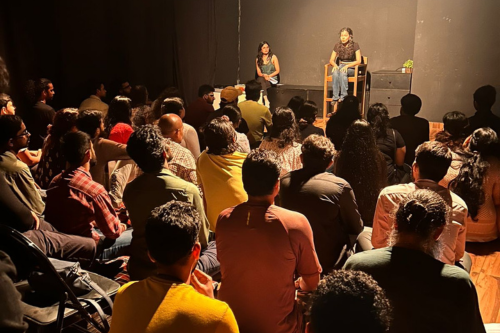
Walk into almost any acting classroom on day one, and you would expect to hear lines, watch scenes, or see students practising expressions in front of a mirror. Instead, at Rangshila Theatre Group, the first lesson often looks deceptively simple: students lie on the floor, hands resting on their stomachs, and simply breathe. No dialogue. No character work. Just breath.
This surprises almost everyone. However, breath control for actors is not a warm-up exercise tucked in before the “real” training begins. It is the real training. Every technique that follows, from voice projection and emotional access to stillness on stage, is built upon it. Without a trained breath, an actor’s instrument is incomplete before they have even spoken a single line.
Why Breath Comes Before Voice
Voice is often treated as the actor’s primary tool, and rightly so-a trained voice can fill a 300-seat auditorium without a microphone or crack with grief on cue.
Yet voice itself is nothing more than controlled breath passing through the vocal folds. A shaky, shallow breath produces a shaky, shallow voice, no matter how talented the actor.
This is why many acting classes in Mumbai that focus purely on vocal projection, without first addressing breath mechanics, often produce performers who can shout but cannot sustain. They run out of air mid-sentence, their pitch rises under stress, and their voice thins out exactly when the scene demands more control. This is wherebreath control for actors becomes essential-it addresses the problem at its source instead of patching symptoms.
At Rangshila Theatre Group, students are taught to see breath as the engine and voice as its output.
Before any vocal exercise begins, training focuses on how the actor breathes at rest, under stress, and during movement, ensuring the instrument is stable in every condition.
The Physiology Every Actor Should Understand
Most untrained performers breathe shallowly, using only the upper chest. This is sufficient for daily conversation but collapses under the demands of the stage-whether projecting to the back row, holding a note, or delivering a monologue without gasping between sentences.
Diaphragmatic breathing, sometimes called belly breathing, is the foundation taught early in any serious acting institute in Mumbai. It is central to breath control for actors.
The diaphragm is a large muscle beneath the lungs that enables deeper, controlled breathing with a slow and even release. Actors trained in this way can speak for longer periods, project their voice further, and recover more quickly between lines.
Moreover, this form of breathing directly affects the nervous system. Slow, deep breaths activate the parasympathetic nervous system, calming the body. In contrast, rapid shallow breathing triggers the fight-or-flight response, which most actors experience as stage fright. In simple terms, controlling the breath is also a way of controlling fear itself.
Breath as an Emotional Tool, Not Just a Technical One
It would be a mistake to treat breath control purely as a technical skill separate from emotional truth. In fact, breath is often the actor’s most honest signal. A held breath shows tension before a single word is spoken. A shaky exhale reveals grief the script has not yet named. A sudden, sharp inhale can land harder than a scream.
Instructors at Rangshila’s acting classes in Mumbai often remind students that audiences read breath instinctively, even if they cannot name what they are seeing. Therefore, an actor who has trained breath control for actors develops access to a vocabulary of emotion that untrained performers simply do not have.
This is closely tied to sense memory and emotional recall techniques. Actors learn to observe how their breath changes when accessing real memories. Instead of forcing an emotional reaction, a trained actor allows the breath to shift first. Emotion follows naturally rather than being performed from the outside in.
Breath and Stillness – The Quiet Partnership
Stillness is often praised in acting as a mark of confidence and control. However, stillness without breath awareness quickly reads as stiffness rather than presence. The difference between an actor who looks frozen and one who looks powerfully still almost always comes down to breath.
A grounded actor standing motionless is still breathing visibly and deliberately, allowing the audience to see the subtle rise and fall that signals a living, thinking person. This is why breath control for actors is paired closely with stillness training in a well-structured acting workshop in Mumbai-the two skills reinforce each other rather than existing separately.
Breath Control Under Pressure – Auditions and Live Performance
Nowhere is breath control tested more directly than in a live audition or an unscripted moment on stage. Nerves shorten the breath. A shortened breath weakens the voice. A weakened voice undermines even the strongest preparation.
Actors who have trained breath control for actors develop a reliable tool to return to under pressure. Before walking into a cold reading, before stepping into a spotlight, before a scene partner forgets a line and the moment threatens to unravel-breath is the one thing an actor can always control, even when nothing else in the room is predictable.
This is one of the most practical reasons acting training in Mumbai places such heavy emphasis on breath drills early in the process. It is not simply about sounding better. It is about giving the actor something steady to hold onto when everything else feels uncertain.
How Rangshila Builds Breath Training Into the Curriculum
At Rangshila Theatre Group, breath work is not confined to a single introductory class—it is woven through every stage of training. The Instrument stage, which focuses on voice modulation and body awareness, begins with diaphragmatic breathing before layering in projection and articulation. Later, as students move into The Craft and work on sense memory and improvisation, breath awareness becomes the bridge between technical control and genuine emotional access.
This structured, layered approach reflects Rangshila’s broader philosophy as one of the leading acting classes in Mumbai. Strong actors are built from the ground up, not from flashy technique alone. Breath control for actors remains central throughout the learning process. Founded in 2008 by Avneesh Mishra, Rangshila has trained thousands of students through this method, many of whom credit their vocal stamina and emotional control directly to the breath training they received in their earliest sessions.
Simple Breath Exercises Every Actor Can Start Today
For those not yet enrolled at an acting school in Mumbai but wanting to begin developing breath control for actors, a few foundational exercises can quickly build early breath awareness:
Lie flat on your back, place a hand on your stomach, and breathe so that your hand rises and falls rather than your chest.
Practise a slow four-count inhale, a four-count hold, and an eight-count exhale to build breath control while also calming the nervous system.
Read a paragraph aloud on a single breath, then gradually extend the length of text you can sustain without gasping.
Before any high-pressure moment-an audition, a presentation, or a difficult conversation-take three slow diaphragmatic breaths before speaking.
These exercises are simple, but consistency matters more than complexity. Furthermore, most acting courses in Mumbai revisit these fundamentals throughout training, not just at the beginning, because breath control is a skill that deepens with practice rather than something mastered once and forgotten.
The Bottom Line
Voice training, emotional depth, stage presence and camera confidence all get the spotlight in conversations about acting. Breath-quiet and often overlooked-is what makes every one of them possible. Instead of treating it as a footnote before the real work begins, the strongest actors-and the strongest training programmes-treat breath control for actors as the actual first lesson.
If you are exploring acting classes in Mumbai and want training that builds your instrument from its true foundation rather than skipping straight to performance, Rangshila Theatre Group’s structured curriculum begins exactly where every great actor’s journey should: with breath control for actors.
Frequently Asked Questions
Breath control for actors directly affects voice projection, emotional access, and the ability to stay calm under pressure. A trained breath allows an actor to sustain longer lines, recover faster between scenes, and access genuine emotion rather than forcing it.
Yes. Slow, diaphragmatic breathing activates the body’s calming response, which directly counters the shallow, rapid breathing associated with stage fright. Breath work is often taught before more advanced performance techniques at structured acting institutes in Mumbai.
Breath control matters just as much on camera. Even though screen acting requires subtler expression, a controlled breath keeps the voice steady during close-ups and helps actors stay grounded in moments of stillness.
Many students at Rangshila’s acting classes in Mumbai notice improved vocal stamina and calmness within a few weeks of consistent practice. Breath control, however, is a skill that continues to deepen over time and is not mastered in a single session.
No. Diaphragmatic breathing exercises require nothing more than a quiet space and a few minutes a day. This makes it one of the most accessible parts of actor training, whether you are enrolled in an acting workshop in Mumbai or practising independently before joining one.