
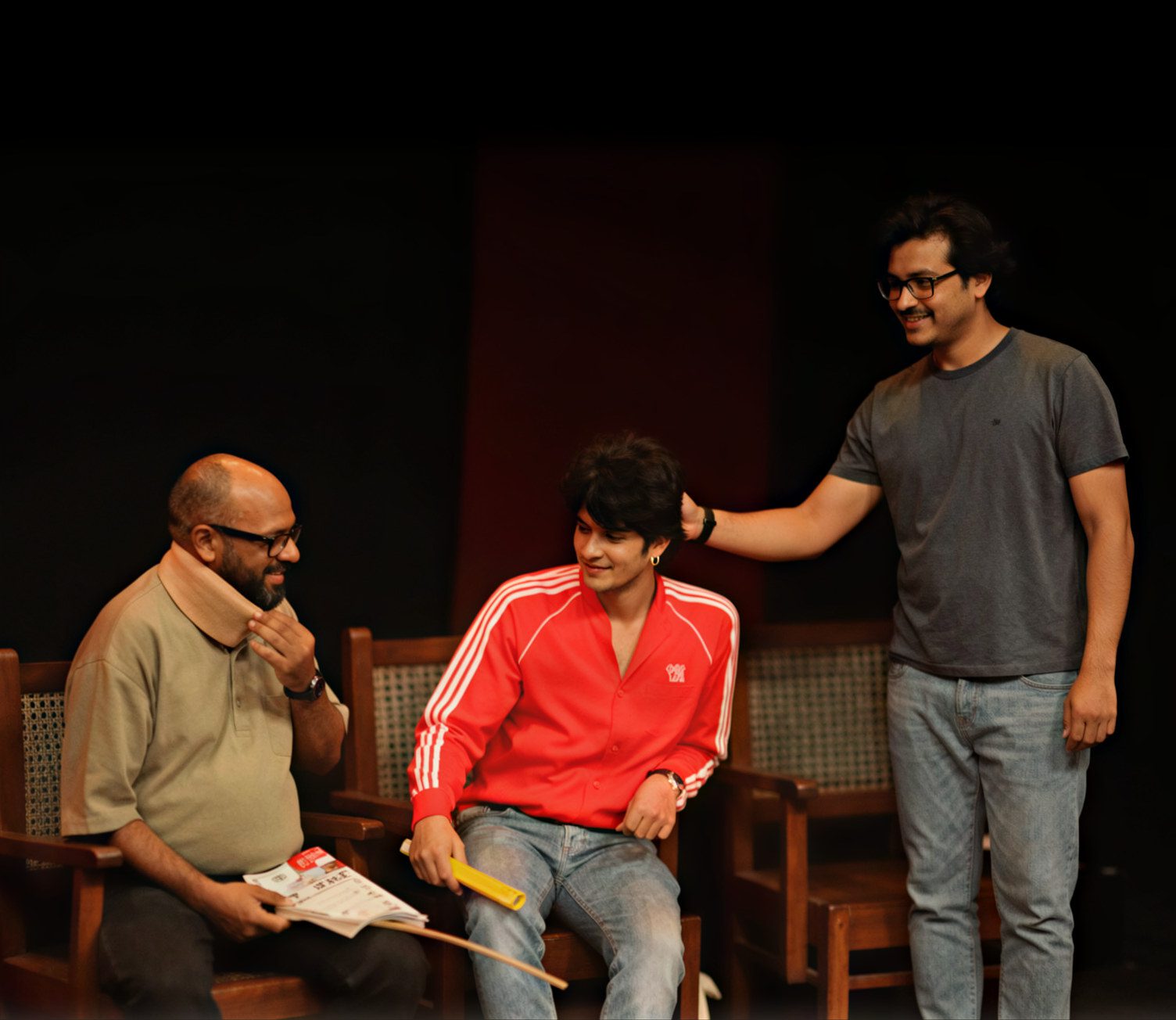
You arrive at the audition. You have prepared your monologue, researched the project, and rehearsed until you felt ready. Then the casting director hands you a script you have never seen before and asks you to perform it in five minutes.
This is cold reading acting – and for many aspiring performers, it is one of the most intimidating parts of the audition process. Unlike a prepared monologue, a cold reading gives you little time to analyse, rehearse, or refine. You must take an unfamiliar script and bring it to life immediately, under pressure and in front of decision-makers.
At Rangshila Theatre Group, one of the most respected acting schools in Mumbai, we train our students specifically for moments like these. Cold reading is not just a test of performance under pressure – it is a test of how deeply your craft has become instinctive. In this blog, we break down what cold reading acting demands and how you can prepare for it effectively.
What Is a Cold Reading in Acting?
A cold reading in acting is when an actor is given a script or scene they have never seen before and asked to perform it with little or no preparation time. In professional auditions for theatre productions, Bollywood films, OTT web series, and television, cold readings are extremely common.
Casting directors use cold readings for several reasons. First, they reveal how an actor thinks on their feet – their instinctive choices, ability to make quick decisions, and responsiveness in the moment. Second, they test the quality of an actor’s training. An actor who has deeply internalised the principles of good acting will usually perform a cold reading far better than one who relies mainly on rehearsal and preparation.
Most importantly, cold readings reveal something that prepared monologues cannot: how an actor responds when the safety net of memorisation is removed.
Why Cold Reading Acting Is a Distinct Skill
It is important to understand that cold reading acting is not simply unprepared acting. It is a distinct skill with its own principles, techniques, and best practices – one that can be developed and refined through deliberate practice.
The actors who excel at cold readings are not necessarily the most talented performers in the room. They are the ones who have internalised core principles so deeply that they can apply them instantly, without overthinking. At our acting institute in Mumbai, we develop these principles throughout the four stages of training, ensuring that by the time students face a professional cold reading, their instincts are already working for them.
1. Scan Before You Perform – Use Every Second of Preparation Time
When you are handed a cold reading script, you will typically have a few minutes before you are expected to perform. Use every second of that time strategically.
Do not start from the beginning and read straight through. Instead, scan the scene quickly with these questions in mind:
- Who is my character? What do you know about them from context clues in the dialogue?
- What does my character want in this scene? What is their objective – what are they trying to get, change, or achieve?
- What is the emotional situation? What has just happened before this scene begins? What is at stake?
- What is the relationship between the characters? Are they friends, strangers, lovers, or enemies?
These four questions – character, objective, situation, and relationship – provide the essential framework for any scene. Even a quick scan of the text through this lens will give you far more to work with than a word-by-word read-through.
At Rangshila Theatre Group, our acting courses in Mumbai train students in script analysis as a foundational skill, so that reading a scene quickly and extracting its essential elements becomes instinctive rather than effortful.
2. Make a Strong Choice – Then Commit to It
The most common mistake actors make during a cold reading is hedging. They make a tentative, vague choice about who their character is and what they want – and then perform the scene at half-commitment, as if they are still deciding.
This approach produces exactly the kind of flat, unclear performance that casting directors find forgettable.
Instead, make a specific choice – even if it is not the perfect choice – and commit to it completely. A bold, clear, fully committed choice that turns out to be slightly off is far more impressive than a cautious, hedged performance that covers all bases and illuminates nothing.
Casting directors know that cold readings happen under pressure. They are not expecting a fully polished performance. However, they are looking for actors who can make clear, specific, committed choices quickly – because that is precisely the skill required on a professional set or stage.
At our acting school in Mumbai, we consistently challenge our students to commit to bold choices in scene work, building the habit of decisive, specific performance that translates directly to cold reading situations.
3. Keep Your Eyes on the Page – But Not Only on the Page
One of the practical challenges of cold reading acting is managing the physical act of reading while still performing truthfully. Many actors become so focused on not losing their place on the page that they never look up – and the performance becomes a recitation rather than an interaction.
The technique most professional actors use is this: anchor a line or phrase in your memory, look up to deliver it to your scene partner or reader, then return to the page for the next line. This creates the impression of genuine engagement and eye contact without losing your place in the script.
It is perfectly acceptable in a cold reading to glance at the script. Casting directors know you have not had time to memorise the text. What they are watching is not your memorisation – it is your acting. The moments when you look up from the page are where the performance comes alive.
If you are reading with a scene partner or reader provided by the casting team, listen to them genuinely. Their responses – even if delivered flatly – give you something real to react to. Reacting truthfully to what you actually hear is one of the hallmarks of skilled cold reading acting.
4. Prioritise Listening Over Line Delivery
This principle is central to everything we teach at Rangshila Theatre Group – and it is nowhere more important than in a cold reading.
In a prepared monologue, the temptation to focus on delivery is strong but manageable. In a cold reading, the temptation is almost overwhelming because you are simultaneously reading, processing, and performing. It is easy for your focus to collapse entirely onto the words themselves.
Resist this. In a cold reading, your primary job is to listen and respond – not simply deliver lines. The words are a vehicle, not the destination. The performance lives in the spaces between the words: in how you receive what the other person says, what it does to you, and what you decide to do next.
Actors who can maintain genuine listening in a cold reading situation – even while holding a script – are the ones who consistently impress casting directors. Genuine listening is impossible to fake, and it creates the sense of aliveness that distinguishes performance from recitation.
5. Do Not Apologise for the Cold Reading
This sounds simple, but it is one of the most important pieces of advice for cold reading acting: do not apologise, explain, or make self-deprecating comments about the fact that you are reading from a script.
Many actors, particularly less experienced ones, begin a cold reading with disclaimers such as, “I haven’t had much time to look at this,” or “I’m not sure I’ve quite got this yet.” These statements communicate insecurity and immediately lower the casting director’s confidence in your ability to handle pressure professionally.
Instead, take a breath, make your choice, and begin. If you stumble, recover cleanly and continue. Professionalism under pressure is itself one of the qualities that casting directors look for in a cold reading – and demonstrating it begins the moment you pick up the script.
6. Practise Cold Reading Regularly
The most effective preparation for cold reading acting is consistent practice. This means regularly picking up scripts you have never seen before and performing them immediately – alone, with a friend, or in a class environment.
Some specific practices that develop cold reading skills include:
- Newspaper practice – Pick up an article you have never read and read it aloud immediately, with expression and intention. This builds the skill of making meaning instantly from unfamiliar text.
- Scene partner cold reads – Exchange scripts with a fellow actor and perform them immediately, with no prior discussion or preparation.
- Diverse reading – Read as many scripts as possible across different genres, periods, and styles. The broader your exposure to dramatic writing, the more quickly you can orient yourself in unfamiliar material.
At Rangshila Theatre Group, our acting workshop in Mumbai programmes incorporate cold reading exercises because we understand that this is a skill casting directors actively test – and one that can be systematically developed through regular practice.
7. Trust Your Training
Finally, the most important thing you can bring to a cold reading acting situation is trust – trust in your training, your instincts, and your ability to find something true in any material under any circumstances.
Cold readings reveal the depth of an actor’s craft because they strip away the safety net of preparation. What remains is the quality of your training – the instincts, listening skills, emotional availability, and physical and vocal presence you have developed through consistent, structured work.
This is why training at a structured acting school in Mumbai like Rangshila Theatre Group is so important for actors who want to perform well in cold reading situations. The principles you internalise through our four-stage programme – The Outlook Training, The Instrument, The Craft, and The Technique – become part of your instinctive response to any acting situation.
When you are handed an unfamiliar script with five minutes to prepare, you are not starting from scratch. You are drawing on a deep reservoir of embodied craft that no amount of pressure can take away.
How Rangshila Theatre Group Prepares Actors for Cold Readings
Founded by Awnish Kumar Mishra on 18th January 2008, Rangshila Theatre Group has established itself as one of the most trusted acting schools in Andheri West, Mumbai. With over 500 theatre enthusiasts trained, 250+ performances across 100 venues, and alumni working across theatre, Bollywood, and OTT platforms, the institute has built a strong reputation for practical, performance-focused training.
Our four-stage training programme is designed to develop the instinctive craft that cold reading acting demands. Through The Outlook Training, The Instrument, The Craft, and The Technique, students build the script analysis skills, listening ability, physical presence, and professional confidence needed to perform effectively under pressure.
The Technique stage includes dedicated audition preparation, including cold reading exercises and camera acting sessions. This gives students direct experience of the professional audition environment before they encounter it in the real world.
We offer acting classes in Mumbai across weekday and weekend batches, along with acting classes for beginners in Mumbai who are taking their first steps into the performing arts.
Frequently Asked Questions
A cold reading in acting is when an actor is given a script or scene they have never seen before and asked to perform it with little or no preparation time. It is common in theatre, film, television, and OTT auditions. Cold readings test an actor’s instincts, decision-making ability, and training.
Preparation time can range from just a few minutes to around fifteen or twenty minutes. Regardless of the time available, the key is to focus on the character, objective, situation, and relationships within the scene and make clear, committed choices.
Absolutely. Cold reading is a skill that improves through regular practice. Exercises such as scene partner reads, script analysis, and structured acting training help actors build the confidence and instincts needed to perform well under pressure.
No. The goal is not to memorise the script but to perform truthfully while using the text as a guide. Looking up to connect with your scene partner while referring back to the script is a common and effective technique
Casting directors look for clear choices, genuine listening, strong presence, and professionalism under pressure. They are less concerned with perfection and more interested in seeing an actor’s instincts, adaptability, and training in action.
The Bottom Line
Cold reading acting is not about performing perfectly under impossible conditions. It is about demonstrating that your craft is so deeply internalised that it works even when the safety net of preparation is removed. It is about making bold choices quickly, listening genuinely, committing fully, and handling pressure with the confidence of a well-trained professional.
The good news is that cold reading is a skill – and like any skill, it can be developed, refined, and strengthened through consistent practice and structured training.
If you are ready to build the craft that makes cold reading – and every other aspect of professional acting – feel natural rather than intimidating, Rangshila Theatre Group is here to help. Explore our Acting School in Mumbai page or get in touch with us to learn more.