
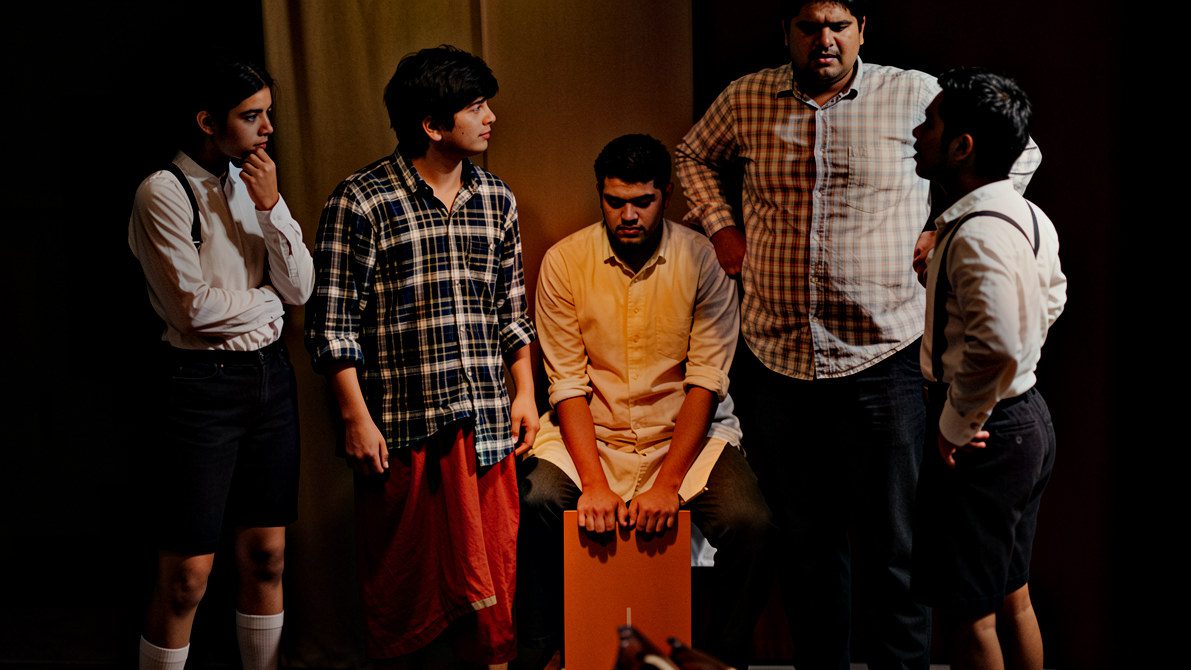
A group of actors sits in an empty rehearsal room. The only thing on the wall is a single word: waiting. There is no script, no assigned characters, and no dialogue to learn. Over the next few weeks, they build an entire performance from that one word. They use improvisation, physical exercises, and different versions of scenes to develop the piece. The group debates what to keep and what to remove. Many scenes never make it to opening night.
Devised theatre is a collaborative way of creating a performance without starting from a pre-written script. Instead, actors and other members of the creative team generate material from a theme, image, question, personal experience, research, or a set of exercises. The material is then selected, shaped, and refined into a finished performance. This article explores how that process works and why it develops skills that are valuable even for actors who primarily plan to work from scripts.
What Devised Theatre Actually Means
Devised theatre is often confused with improvisation as a performance form, but the two aren’t the same thing. Improv, in its pure form, is created live in front of an audience and can change with every performance. Devised theatre often uses improvisation during the creation process. However, the final performance usually has a clear structure. Actors refine and repeat it much like a scripted show. The key difference is how the group creates that structure.
In scripted theatre, a playwright writes the text before rehearsals begin, and the actor’s role centres on interpreting it. In devised theatre, actors, usually working with a director or facilitator, generate material together through movement, personal stories, research, improvisation, or structured exercises. They then shape that material into a finished performance over time. The actor isn’t just interpreting a text; they’re helping to author the work.
Where Devised Theatre Comes From
Collective creation has roots stretching back further than any single movement, but the practice as it’s commonly understood today developed significantly through experimental theatre companies in the mid-to-late twentieth century. Many of these companies challenged the idea that a director’s or playwright’s vision should simply be handed down to actors to execute.
Jerzy Grotowski’s work on the actor’s physical and psychological training, detailed in Towards a Poor Theatre, contributed to broader developments in actor-centred and experimental theatre by treating the actor’s body and presence as creative material, rather than simply a vehicle for someone else’s words. In India, Badal Sircar’s Third Theatre movement developed performance through community engagement and collective processes, working outside conventional proscenium theatre and contributing to India’s tradition of low-resource, community-oriented theatremaking.
Contemporary companies continue to develop these approaches in different forms. Complicité has built an international reputation for ensemble-based physical storytelling. Frantic Assembly has also published devising methods based on physical composition and collaborative exercises. These methods make its creative process accessible to actors and teachers beyond the company.
How a Devised Piece Actually Gets Made
Every devising process looks slightly different, but most follow a recognisable shape.
1. Start With a Prompt
The process usually starts with a prompt rather than a plot. This could be a theme, image, piece of music, personal story, or research. The ensemble then explores the idea through different exercises. Unlike a script, a prompt does not tell performers what happens. Instead, it gives them a starting point.
2. Generate Material
From there, the ensemble generates material through improvisation, physical exercises, writing, and structured tasks. The group often creates far more content than the final piece will use. This stage can feel uncertain because nobody knows which ideas will survive. The ensemble must explore different possibilities before deciding what works.
3. Select What Works
The group reviews the material it has created and decides what is worth keeping. This stage can involve disagreement, experimentation, and negotiation. The ensemble looks for material with the strongest potential and develops those ideas further.
4. Structure the Material
The ensemble then arranges the surviving material into a sequence that builds meaning and momentum. Raw material rarely arrives in a usable order. The group must decide how individual scenes, movements, ideas, and moments fit together.
5. Refine and Rehearse
Finally, the ensemble refines and rehearses the piece until it is ready for performance. Some companies leave parts of a devised piece flexible or semi-improvised. However, many fix most of the material before an audience sees it.
Devised Theatre vs Scripted Theatre
| Aspect | Scripted Theatre | Devised Theatre |
| Starting point | A completed script | A theme, image, question, or exercise |
| Actor’s role | Interpreting a fixed text | Co-authoring material through improvisation and discussion |
| When text is fixed | Before rehearsals begin | Often only in the final stages, if at all |
| Ownership of material | Usually attributed to the playwright | Often shared among the ensemble or credited according to the production’s authorship arrangements |
| Rehearsal process | Focused on interpretation and blocking | Focused on generating, selecting, and structuring material |
The Actor’s Role in Devising
Devising asks something genuinely different of an actor than script work does. Instead of interpreting someone else’s choices, the actor has to generate original material and offer it to the group, knowing much of it won’t be used. That requires a specific kind of confidence – the willingness to make a bold choice in an improvisation, have it rejected or reshaped by the ensemble, and offer the next idea without taking the rejection personally.
Devising also demands a sustained tolerance for ambiguity. When rehearsing a script, actors already know how the story ends. In devising, the process can run for weeks without a clear idea of what the final piece will look like. Actors working with finished scripts also need to understand how a scene works. See our guide to Script Analysis for Actors: How to Break Down Any Scene. Actors who thrive in this process tend to feel comfortable generating ideas under uncertainty. They also listen closely and build on what their scene partners offer.
Common Techniques Used in Devising
Viewpoints was developed by Mary Overlie and later expanded by Anne Bogart and Tina Landau. It gives ensembles a shared vocabulary for exploring and structuring movement and performance. Elements such as tempo, duration, repetition, and spatial relationships help actors generate material together. The process does not rely on a script to organise the work.
Augusto Boal’s Theatre of the Oppressed introduced a range of games and exercises. He documented these methods in Games for Actors and Non-Actors. The exercises help groups create collective and participatory performances around real social questions. They focus on these questions rather than fictional plots created in advance.
Verbatim theatre is a related approach that can develop through devising. It uses real interviews, testimony, or recorded speech as source material. Instead of relying entirely on invented dialogue, the performance draws from the words and experiences of real people.
Physical devising methods generate material through structured physical composition and ensemble exercises. Companies such as Frantic Assembly practise and publish these methods. Actors can develop movement and scenes before any dialogue is written.
Common Misconceptions About Devised Theatre
Some people assume that devised theatre lacks the structure or discipline of scripted work because it does not start with a finished text. In practice, devising can demand even more discipline. The ensemble must develop, test, and justify many of the structural decisions that a playwright would normally make.
There’s also a tendency to assume devising is essentially an extended improv session with no real plan. In many devised productions, the material is fixed and repeated consistently once the process is complete, much like a scripted show. The improvisation often happens during the creation process rather than in what the audience eventually sees, although some productions intentionally leave parts of the performance flexible or semi-improvised.
Why Devising Is Valuable for Actor Training
Even actors who mainly intend to work from scripts can benefit from devising experience because it builds skills that script work alone doesn’t always demand. Devising trains actors to generate original, specific choices rather than waiting to be told what to do, strengthening instinct and confidence in any rehearsal room, scripted or not. This kind of practical, collaborative training is also central to what actors can expect from a strong acting school in Mumbai.
It also builds a structural understanding of drama from the inside – an actor who has helped build a scene from nothing can understand, in a very practical way, why a scripted scene is structured the way it is. And because devising depends heavily on genuine ensemble listening, it sharpens the reactive, present-moment skills that are central to strong acting, including in scripted work.
Devising also helps actors become more responsive and specific in their choices rather than relying on exaggerated expression. For a related look at truthful performance, see our guide to overacting vs natural acting.
How Rangshila Theatre Group Uses Devising in Training
Founded by Awnish Kumar Mishra on 18th January 2008, Rangshila Theatre Group has trained more than 2,000 students in Versova, Andheri West, Mumbai. Devising principles are incorporated into parts of the curriculum, giving students experience with collaborative creation before they work extensively with finished scripts.
The Outlook stage builds observational habits – noticing real behavior, gestures, and details in the world around them – that can later become source material for devised and improvised work. The Craft stage introduces structured generation and collaborative scene-building, giving students direct experience of shaping material from the ground up rather than only interpreting text that’s already complete. This experience can also support scripted work, as students who have devised material firsthand develop a more active understanding of structure and scene-building.
Rangshila’s faculty, trained at institutions including BNA and NSD, incorporate devising exercises because they help develop initiative, collaboration, and creative decision-making alongside traditional script-based acting skills.
The Bottom Line
Devised theatre strips away the one thing many actors are trained to rely on first – a finished script – and asks the ensemble to build the performance collaboratively from the ground up. The process can be uncomfortable, uncertain, and often slower than working from a completed script. It can also be an effective way to develop the instincts, structural understanding, and collaborative confidence that actors can apply to many kinds of work, scripted or otherwise.
If you’re curious about developing these skills through hands-on, collaborative training, explore our acting classes in Mumbai or get in touch with us directly.
Frequently Asked Questions
No. Improvisation is usually created spontaneously during a performance, while devised theatre uses it as a tool to create the performance. The final piece is usually structured and rehearsed.
Do devised performances ever use a script?
Yes. Many devised pieces eventually develop a fixed script or performance text. The difference is that the text is created during the devising process rather than written in advance by a single playwright.
Not necessarily. Devising is used across community theatre, verbatim theatre, physical theatre, and ensemble productions, as well as experimental work.
There is no fixed timeline. A devised project can take a few weeks to several months, depending on the production, ensemble, and creative process.
Do actors get credited as writers in devised work?
Often, yes, when actors substantially contribute to the performance text or structure. However, credit practices vary between productions.
Yes. Devising can develop creative problem-solving, scene awareness, initiative, and ensemble listening – skills that can also strengthen an actor’s work on camera.