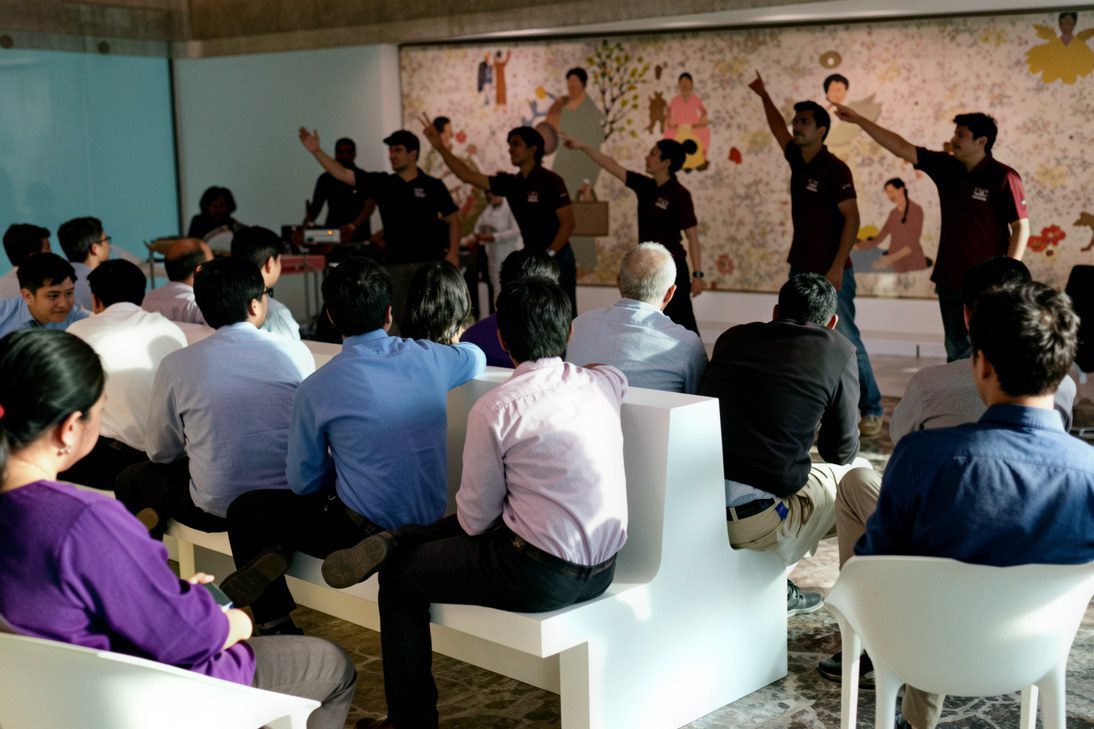
Imagine walking into a theatre workshop expecting to read scenes and learn how to deliver lines. Instead, you spend the first hour walking silently around a room, making eye contact with strangers, and mirroring a partner’s movements. More than once, you’re also asked to simply notice your own breathing. At first, it may not be obvious what any of this has to do with acting. But by the time scene work begins, these exercises are already building the skills an actor needs to perform with greater presence, awareness, and responsiveness.
A theatre workshop typically moves through a structured arc – physical and vocal warm-ups, ensemble and trust-building exercises, improvisation, and then applied scene or character work – and each stage targets a specific skill that shows up directly in performance later. None of it is filler before the “real” acting begins. The exercises are the training. This piece walks through that arc stage by stage, and what each part is actually building toward.
Why Workshops Don’t Start With Scripts
It’s a common assumption that acting training should start with a script, since that’s what the finished work looks like. In practice, script work assumes an actor already has a working level of presence, listening ability, and physical and vocal control. These are the skills that workshop exercises specifically build.
Handing an inexperienced actor a scene before building these foundations can lead to technically correct line delivery. There may be very little truthful behaviour behind it. Building the underlying skills first, even through exercises that don’t resemble acting at all on the surface, tends to produce far more honest scene work once text does enter the room.
The Warm-Up: Why It’s Not Just “Getting Loose”
People often mistake physical warm-ups for a formality before the “actual” work starts. Their real purpose is releasing physical tension that would otherwise show up as stiffness, nervous mannerisms, or restricted movement once a student is actually performing. An actor carrying unconscious tension in their shoulders or jaw has less physical availability to commit fully to a character’s behaviour.
Vocal warm-ups serve a parallel function for the voice. They build breath support, release tension in the throat and jaw, and prepare the articulators for clear, sustained speech.
Kristin Linklater’s work on vocal training focuses on freeing the voice from habitual tension. This allows the voice to be trained further. This is the logic behind starting a session this way. Skipping this stage can make vocal work less comfortable and may increase the risk of unnecessary vocal tension during demanding performance work.
Trust and Ensemble Exercises
The exercises that look least like traditional acting – eye contact exercises, mirroring, group rhythm work – are often doing some of the most important groundwork in an entire workshop. Acting is a deeply relational skill; it depends on genuinely seeing and responding to a scene partner, not performing convincingly in isolation.
Trust and ensemble exercises build exactly this capacity. They train a student to stay present with another person, notice subtle shifts in behaviour, and respond honestly, without the added pressure of dialogue or a character to manage at the same time. This tradition draws directly on the game-based training pioneered by Viola Spolin, whose work treats structured play as a genuine method for building spontaneous, truthful behaviour between performers, and on Augusto Boal’s collaborative exercises, which use shared physical and social tasks to build the same kind of ensemble awareness.
Improvisation: Building Spontaneity and Listening
Improvisation shows up in workshops that have nothing to do with comedy, because its real function isn’t generating jokes – it’s training an actor to respond truthfully in the moment, without the safety net of pre-planned lines. Keith Johnstone’s influential work on improvisation, documented in Impro: Improvisation and the Theatre, treats spontaneity itself as a trainable skill, built through structured exercises rather than natural talent alone.
This matters even for actors who plan to work exclusively from scripts. An actor who has trained genuine spontaneity through improvisation tends to bring a more alive, reactive quality to scripted scenes as well. Listening and responding honestly doesn’t stop being necessary just because the words are already written, whether the actor is working from a script or contributing to devised theatre.
Workshop Exercise Types and the Skills They Build
| Exercise Type | What It Looks Like | Skill It Builds |
| Physical warm-up | Stretching, movement, physical games | Releasing tension and building body awareness |
| Vocal warm-up | Breath work, articulation exercises | Vocal clarity, control, and stamina |
| Trust and ensemble exercises | Eye contact, mirroring, group rhythm work | Genuine listening and reacting to a scene partner |
| Improvisation | Unscripted scenes, spontaneous response games | Spontaneity, presence, and adaptability |
| Scene or character work | Applying character or scene breakdown to a text or improvised scene | Integrating all previous skills into a full performance |
How Exercises Connect to Scene Work Later in the Workshop
The connection between early exercises and later scene work is rarely explained in the moment, which is part of why it can feel disconnected while it’s happening. An ensemble exercise built entirely around noticing a partner’s small physical shifts directly becomes the listening skill an actor uses in a two-person scene later, when noticing a scene partner’s genuine reaction matters far more than remembering the next line. A physical warm-up exercise built around releasing tension directly shows up as a wider, freer range of physical choices once a student is actually building a character.
Most workshops are structured so that the exercises done early in a session or over the first few days aren’t separate from the scene work that follows – they’re the direct preparation for it, even when that connection isn’t made explicit until a student experiences it for themselves.
What a Typical Workshop Arc Looks Like Over Multiple Sessions
In a workshop that runs across several days or weeks, the early sessions tend to be weighted heavily toward warm-ups and trust-building exercises, since a group needs a baseline of comfort and safety before deeper character or emotional work can happen honestly. As the workshop progresses, sessions typically shift toward improvisation and then applied scene or character work, often building toward some kind of informal showing or presentation by the end.
A single-day workshop compresses this same arc into a shorter window, but follows the same underlying logic – some warm-up and trust-building at the start, moving toward more applied work as the group’s comfort and shared vocabulary develop over the course of the day.
Common Misconceptions About Theatre Workshops
There’s a common assumption that workshops are primarily for beginners or hobbyists, and that serious training happens elsewhere. In practice, working actors may also attend workshops to maintain fundamental skills or to work with teachers and techniques outside their usual training. The same training can benefit people who approach acting from different starting points, as explored in Can Introverts Become Actors? What Acting Training Actually Changes.
There’s also a tendency to dismiss an exercise as a waste of time if it doesn’t resemble acting on the surface. As covered above, this is usually backwards – the exercises that look least like performance are frequently building the skills that make performance actually work, rather than existing as a warm-up formality before the “real” training begins.
How Rangshila Theatre Group Structures Its Workshops
Founded by Awnish Kumar Mishra on 18th January 2008, Rangshila Theatre Group has trained more than 2,000 students in Versova, Andheri West, Mumbai, and its work as an acting school in Mumbai includes workshops that follow the same underlying structure as its longer-term training, compressed into a shorter, focused format.
Early workshop sessions draw on The Outlook and The Instrument stages of our curriculum, building observation, physical awareness, and vocal readiness before students are asked to build a character or perform a scene. Later sessions move into elements of The Craft, applying that groundwork to improvised or scripted scene work, so students can see how each exercise connects to actual performance, not just a list of activities completed.
Our faculty, trained at institutions including BNA and NSD, design workshop sessions to make this connection visible by the end of the experience, helping students understand how the exercises relate to the performance work that follows.
The Bottom Line
A theatre workshop that starts with breathing exercises, eye contact, and unscripted games isn’t avoiding the “real” acting work – it’s building it from the ground up. Presence, listening, vocal control, and spontaneity aren’t things a script can teach on its own; they’re skills built through exactly the kind of exercises that can feel unfamiliar or even strange in the first hour. By the time scene work arrives, those exercises are already doing their job, whether a student notices it happening or not.
If you’re considering joining a theatre workshop, explore our upcoming theatre workshops to see what training opportunities are currently available.
Frequently Asked Questions
No. Many theatre workshops are designed to build foundational skills from the ground up, starting with physical and vocal warm-ups and ensemble exercises that can accommodate participants with no prior training. Beginners can make up a significant portion of a workshop group.
These exercises build the underlying skills, like presence, listening, and physical and vocal control, that scene work depends on. Skipping straight to scripts without this groundwork can produce technically correct but emotionally surface-level performances.
A workshop typically compresses foundational training into a shorter, focused format, while a full course develops the same skills in greater depth over a longer period. A workshop can also serve as an accessible starting point before committing to longer-term training.
Workshops often build toward performance gradually, starting with lower-pressure exercises like warm-ups and partner-based trust work before introducing scene work. Full performance or presentation elements may come later in the session or course, once the group has built some shared comfort.
This varies widely, from a single intensive day to several weeks of shorter sessions. Regardless of length, many workshops follow a similar arc, moving from warm-ups and trust-building exercises toward more applied scene or character work as the group progresses, much like the progression used in acting classes and fees in Mumbai.
Yes. Working actors may return to workshops to maintain foundational skills, explore techniques outside their usual training, or work with teachers whose approaches differ from their previous trai