
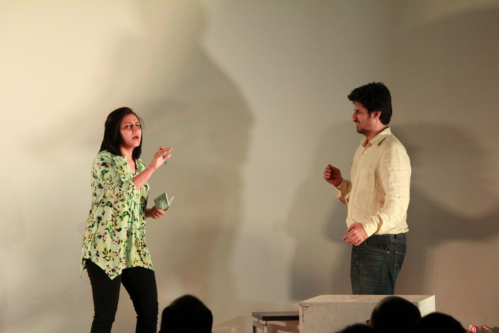
There comes a point in every actor’s journey when acting stops feeling like acting. The tears are no longer forced. The emotions feel real. Something personal begins to surface beneath the performance. And yet, moments later, the scene ends-and the actor must return to everyday life as if nothing happened.
This is the paradox of sense memory in acting. It asks you to experience real emotion while staying fully in control of your craft.
At Rangshila Theatre Group, this isn’t treated as a warning-it’s treated as a foundation.
What Is Sense Memory in Acting?
Sense memory is an acting technique where performers use sensory details from past experiences to create authentic emotions during a scene. Instead of forcing feelings, actors recall sights, sounds, smells, or physical sensations, allowing emotions to emerge naturally while maintaining control over their performance.
Quick Take
- Sense memory helps actors create authentic emotional performances.
- The technique uses sensory recall instead of forcing emotions.
- Emotional control is just as important as emotional expression.
- Safe practice prevents emotional overwhelm.
- Professional acting training teaches actors how to use sense memory responsibly.
- Strong technique improves consistency in theatre and film performances.
How Sense Memory in Acting Works
Sense memory, also known as emotional recall or affective memory, originates from the work of Konstantin Stanislavski and was later expanded by Lee Strasberg in Method Acting.
At its core, the technique is simple:
Instead of forcing an emotion, you recreate the sensory details of a past experience—and allow the emotion to emerge naturally.
The key difference is important. You don’t try to “feel sad.”
You remember the environment:
- What you were touching
- What you could hear
- The temperature around you
- The smell in the air
When these sensory elements are rebuilt with care, the emotion follows on its own—authentic and unforced.
You don’t chase emotion. You recreate the world it came from.
This is what makes sense memory so powerful. It produces performances that feel real, grounded, and immediate-something audiences instinctively connect with.
The Hidden Risk of Sense Memory in Acting
What many actors aren’t told clearly enough is this: sense memory can be dangerous if used without awareness.
When you access deeply personal or painful memories, you’re not just “acting.” You’re reopening something real. And the body doesn’t always distinguish between memory and present reality.
Historically, even in Method Acting spaces, there have been cases where actors became overwhelmed—losing emotional control instead of building it.
That’s why modern training approaches, including those at Rangshila Theatre Group, focus on control over intensity.
The goal is not to suffer for the performance.
The goal is to access, shape, and release emotion-safely and repeatedly.
Sense Memory in Acting vs Emotional Acting Without Technique
| Sense Memory | Emotional Acting Without Technique |
| Uses sensory recall | Relies on forcing emotions |
| Emotion develops naturally | Emotion may feel artificial |
| Focuses on emotional control | Can become emotionally overwhelming |
| Repeatable across performances | Difficult to reproduce consistently |
| Builds authentic performances | May lead to inconsistent acting |
The Most Important Rule: Containment
Before working with emotional memory, actors must build a sense of control.
This starts with a simple but powerful idea: containment.
A containment ritual is a small, intentional physical action-like grounding your feet, taking slow breaths, or saying your name out loud.
It signals to your mind and body:
“I am choosing to enter this emotional space-and I will choose to exit it.”
This is not just a habit. It’s essential for maintaining psychological balance.
These exercises are commonly introduced during professional acting training and should be practised gradually under the guidance of an experienced instructor.
Expert Tip
Never begin sense memory exercises with deeply traumatic experiences. Start with ordinary memories and gradually build emotional control under the guidance of an experienced acting instructor.
A Practical Approach to Sense Memory
Here’s a structured way to practice sense memory while staying grounded:
1. Choose a manageable memory
Don’t begin with your most intense or painful experiences. Start small-moments of mild joy, discomfort, or nostalgia. Build control first.
2. Focus on sensory detail
Avoid telling the story of what happened. Instead, rebuild the environment.
Focus on how everything felt physically. Listen for the sounds that surrounded you. Notice the small sensory details that made the moment memorable.
3. Let emotion come naturally
Don’t force anything. If nothing happens, that’s okay. The process takes time. Trust the technique rather than performing the result.
4. Direct emotion into action
Feeling alone is not acting. The emotion must serve the scene-through dialogue, movement, and intention. Keep it functional, not overwhelming.
5. Exit consciously
Always close the process with intention. Ground yourself physically. Move, breathe, drink water. Remind your body that the experience is complete.
What Good Training Gets Right
The best professional acting training doesn’t separate technique from emotional wellbeing-it combines both. Great actors learn not only how to create authentic emotions but also how to manage them with confidence and control.
At Rangshila Theatre Group, our acting classes in Mumbai focus on building strong acting techniques that help performers enter and exit emotional states safely while delivering believable performances. Students develop emotional awareness alongside voice, movement, character development, and stage presence.
An actor who understands their emotions-and knows how to use them intentionally-will always deliver stronger, more consistent performances than someone who relies only on emotional intensity.
This balanced approach to theatre training prepares actors for stage, film, and OTT productions, where consistency, adaptability, and emotional control are essential.
The belief that great acting requires suffering is outdated. True craft comes from awareness, discipline, technical skill, and the ability to use emotion with purpose-not lose control because of it.
Conclusion
Sense memory in acting is one of the most effective acting techniques for creating genuine and emotionally authentic performances, but it should always be practised with awareness and control. Rather than forcing emotions, actors learn to access authentic feelings through sensory recall while staying fully present in the scene.
With consistent practice and professional guidance, sense memory becomes a reliable tool for theatre, film, and OTT performances. Strong acting is not about losing control-it is about using emotion with intention, precision, and confidence.
With the right acting techniques and theatre training, actors can use sense memory safely while delivering authentic, consistent, and believable performances.
Ready to master sense memory in acting through professional theatre training?
Explore Rangshila Theatre Group’s acting workshops and professional acting training to build confidence, refine your performance skills, and gain practical theatre training in Mumbai.
Frequently Asked Questions
Sense memory is an acting technique that uses sensory details from past experiences to create authentic emotions naturally while maintaining control during a performance.
No. Sense memory is one technique used in Method Acting. It focuses on sensory recall, while Method Acting includes several other approaches to character development.
Yes. Beginners can learn sense memory through guided acting exercises that gradually build emotional awareness, confidence, and control.
Yes, when practiced with proper guidance. Professional acting training teaches actors how to access emotions safely without becoming emotionally overwhelmed.
Emotional control helps actors deliver authentic, consistent performances while staying focused, responsive, and connected to the scene.
Acting classes teach sense memory through guided sensory recall, improvisation, and scene practice, helping actors create believable emotions safely and effectively.